Breakbulk Cargo Solutions for Exporters: Fast, Safe, and Cost-Effective
You’ve just sealed a contract to supply industrial generators to a construction company in Riyadh. The machinery is massive 12 tonnes each, too tall for a standard container, impossible to disassemble without voiding the warranty. Your usual freight forwarder says no. The first port agent quotes a number that makes your eyes water. And your delivery deadline is in three weeks.
This is the reality for hundreds of UAE exporters every year.
The cargo doesn’t fit into a box. But the deal still needs to close.
That’s exactly where breakbulk cargo comes in and if you’ve never used it before, this guide will show you how it works, what it costs, and how to ship it without sleepless nights.
What Is Breakbulk Cargo, Exactly?
Breakbulk cargo is any shipment that cannot be packed into a standard intermodal container.
The term comes from an old maritime phrase: breaking bulk, meaning the unloading of loose goods from a vessel’s hold. Today, it covers a wide category of oversized, overweight, or irregularly shaped freight.
Common examples include:
- Heavy machinery: excavators, cranes, bulldozers, turbines
- Industrial equipment: generators, compressors, boilers, presses
- Infrastructure materials: steel beams, bridge sections, pipe bundles
- Vehicles: yachts, trams, aircraft fuselages
- Renewable energy parts: wind turbine blades, tower sections
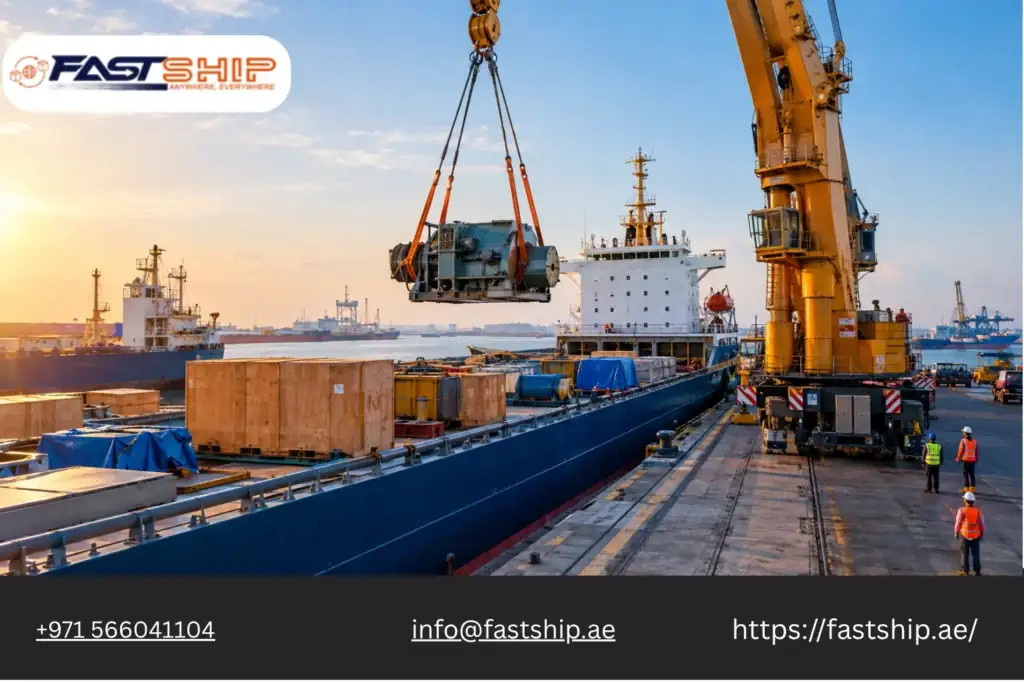
These items are transported in bags, crates, drums, or on pallets and skids — handled individually, piece by piece, rather than as a sealed container unit. Specialist breakbulk vessels come fitted with heavy-lift cranes that manage this cargo faster and more safely than standard dockside equipment.
Why UAE Exporters Are Shipping More Breakbulk Than Ever
The UAE is one of the Gulf’s most active re-export hubs.
Dubai’s Jebel Ali Port — the largest port in the Middle East and one of the top 10 busiest ports in the world — handles millions of tonnes of breakbulk and project cargo annually. As Gulf infrastructure projects accelerate under Saudi Vision 2030, UAE 2031 plans, and Qatar’s post-World Cup development push, demand for specialist heavy cargo logistics is rising sharply.
The GCC construction sector alone is worth over $1 trillion in active project pipelines. Every one of those projects needs cranes, generators, structural steel, HVAC units, and modular components — most of which will never fit inside a 40-foot container.
For exporters based in the UAE, this is a huge opportunity. But only if your logistics partner knows how to handle it.
If you’re moving oversize freight to Saudi Arabia, Oman, Qatar, Kuwait, or Bahrain, getting a proper handle on your options for breakbulk cargo from UAE to GCC will save you significantly on both cost and clearance time.
The Real Cost of Getting Breakbulk Wrong
Most exporter mistakes with breakbulk cargo happen before the ship even leaves port.
Mistake 1: Choosing the wrong vessel type.
Not every cargo ship handles breakbulk. Standard container vessels don’t have the crane capacity or the open hold structure you need. Using the wrong vessel leads to damaged cargo, port refusals, and expensive offloading fees.
Mistake 2: Underestimating customs documentation.
Breakbulk cargo attracts extra scrutiny at GCC borders. Every piece needs its own bill of lading, proper HS codes, accurate weight declarations, and in many cases, a pre-arrival approval from the destination country’s customs authority. One missing document can hold your shipment for days.
Mistake 3: No route planning for oversized loads.
Once cargo arrives at the destination port, it still needs to move to site. Oversized freight requires route surveys, police escorts in some countries, and specialized trailers. This is the step that trips up exporters who only planned for the sea leg.
Mistake 4: Ignoring lashing and securing specs.
Breakbulk freight shifts during transit. Poor lashing causes damage claims that can wipe out your profit margin on an entire deal. Proper securing is both a safety and commercial requirement.
A specialist breakbulk freight forwarder handles all four of these before you’ve had your morning coffee.
How Fast Ship Handles Breakbulk Cargo Across the GCC
Fast Ship is a Dubai-based freight and logistics company with offices in both the UAE and Riyadh, Saudi Arabia — giving you a dedicated team on both sides of the border when it matters most.
Having a team physically present on both ends means breakbulk shipments don’t hit a communication wall the moment they leave Jebel Ali. Saudi customs queries get answered in real time. Destination-side documentation is prepped before the vessel docks.
Here’s what the Fast Ship breakbulk process looks like in practice:
1. Cargo assessment and feasibility planning
Before anything moves, the team evaluates the cargo’s dimensions, weight, and special handling requirements. This determines the vessel type, routing, and port compatibility.
2. Documentation and customs clearance
Every bill of lading, import permit, HS code classification, and customs declaration is handled in-house. There’s no third-party handoff that creates delays.
3. Specialist vessel booking
Fast Ship works with multi-purpose and breakbulk vessels equipped with heavy-lift cranes, ensuring your cargo is loaded, secured, and transported on a ship built for the job.
4. Lashing, securing, and cargo protection
Professional rigging and securing is carried out before departure, with load plans submitted to the vessel’s chief officer for approval.
5. Destination clearance and final-mile delivery
On arrival, whether in Riyadh, Jeddah, Muscat, or Doha, the Fast Ship GCC team handles port clearance and arranges specialized transport to the end location.
This end-to-end model removes the handoff problem that causes most breakbulk delays.
Breakbulk vs. Container: Which One Do You Actually Need?
A lot of exporters default to containers because they’re familiar. But familiarity isn’t always the right call.
| Factor | Standard Container | Breakbulk Cargo |
| Size limit | 40ft length, limited height | No standard size restriction |
| Weight limit | ~28–30 tonnes per box | Handled by piece |
| Best for | Regular, stackable goods | Oversized, irregular, or heavy items |
| Cost model | Per container (FCL/LCL) | Per unit or per tonne |
| Flexibility | Low (fixed dimensions) | High (custom loading plans) |
| Port requirements | Any container terminal | Breakbulk-capable ports and cranes |
If your cargo exceeds container dimensions or cannot be safely loaded into a box without modification, breakbulk is not just a preference — it’s the only viable option.
What Makes a Good Breakbulk Partner in the UAE?
Not every freight forwarder offering “heavy cargo” services actually has breakbulk expertise.
Here’s what to look for:
GCC-specific experience. Border regulations, customs documentation, and import approvals vary significantly between Saudi Arabia, Oman, Qatar, Kuwait, and Bahrain. A forwarder without GCC-specific knowledge will learn on your cargo — and you’ll pay for that education.
In-house customs clearance. Outsourcing customs to a third party adds a handoff and a delay. The best partners clear cargo directly, with their own licensed customs agents.
Physical presence at origin and destination. A team in Dubai and a team in Riyadh — or Muscat, or Doha — who can coordinate in real time, is worth considerably more than a single-country operator with a local agent network.
Transparent pricing. Breakbulk quotes can include port handling fees, crane charges, documentation fees, and inland haulage. A reliable forwarder itemizes all of this upfront, so there are no surprise invoices after delivery.
The Bottom Line for UAE Exporters
Breakbulk cargo is not complicated. But it is specialized.
If you’re moving oversized freight, heavy equipment, or industrial machinery from the UAE to Saudi Arabia or anywhere else in the GCC, the right logistics partner makes the difference. For complex multi-leg shipments, Fast Ship’s project logistics services from Dubai to Saudi Arabia cover every stage — from route surveys and customs clearance to final-mile delivery at your project site.
The Gulf market is growing fast. Infrastructure demand is at an all-time high. And exporters who build reliable heavy-cargo supply chains now will be the ones winning the contracts three years from now.
Your cargo doesn’t have to fit in a box.
It just has to be in the right hands.
Need to move a heavy or oversized shipment from the UAE to the GCC? Speak to the Fast Ship team — offices in Dubai and Riyadh, with full breakbulk, project logistics, and customs clearance services across the Gulf.