
Buy Luxury Property in Dubai: The Complete 2026-27 Investment Guide
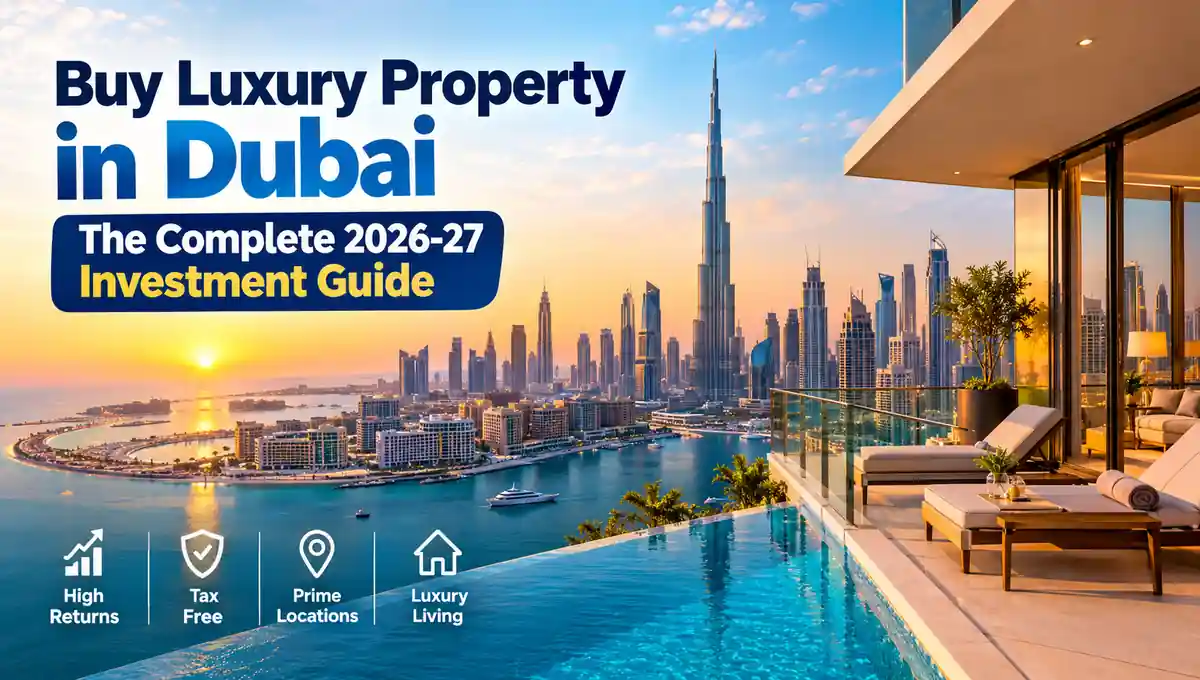
For a decade now, Dubai has revolutionized the world of real estate, and 2026 proves that the luxurious side of Dubai is here to grow and not slow down. Dubai now has more than four million people living within its borders, and with record breaking property transactions in the market, the issue is no longer whether it is a worthy market for investment; rather, it is a matter of timing.
If you have considered buying luxury properties in Dubai but don’t know how, this manual will provide you with all the information necessary, right down to the legal aspects of buying the property.
Why Dubai’s Luxury Real Estate Market Still Leads in 2026
Dubai’s appeal to high net worth individuals may not be new, but the dynamics driving its attractiveness have changed over time. The days when the city would sell its allure through glitz are gone, and buyers in 2026 will factor in the quality of architecture, standards of service and living sustainability equally to that of the spectacular views.
Here are a few basic reasons that have ensured that the allure of Dubai has not diminished:
- Lack of property tax and capital gains tax on the property makes Dubai a very efficient place in terms of taxation.
- Rental yields between 6% and 9%, much higher than most other major luxury markets around the world, even in their core areas.
- Political and economic stability that continues to attract investments seeking security amid the uncertain global environment.
- A growing population that adds 470 people daily, putting pressure in both rental and ownership markets.
This blend of yield, tax efficiency and stability is precisely why so many foreign investors today prefer to buy property in Dubai rather than London, Singapore and New York.
The 2026 Market: What’s Actually Happening
However, it wouldn’t be truthful to say nothing has changed. The volume of transactions is a little bit lower than it was during the last two years because the activity of buyers has become more selective. “Cooling” does not equal “cooling off”; the market rewards selectivity over speculation.
Here’s what you need to know before buying luxury property in Dubai:
Off-plan projects are ahead of resale in the ultra-luxury market. People with substantial capital are favoring branded homes and off-plan projects instead of resale, attracted by the ability to customize their homes while paying flexible installment plans.
Limited availability of waterfront properties drives the valuation. Areas where there are only limited supplies of waterfront land such as Palm Jumeirah, Dubai Island, and Emaar Beachfront are experiencing the most resilient prices due to the inability for supply to keep up with the demand.
Luxury sales are still ongoing. Millions-dirham deals in places like La Mer, Orla on Palm Jumeirah, and Dubai Water Canal are proof that even as markets stabilize, high-end deals remain extremely liquid.
Transit-Oriented luxury projects are becoming popular. With transit becoming as important an asset as the address, there are many luxury developments that have been sprouting near planned metro areas.
Where to Buy Luxury Property in Dubai
Not all luxuries are the same and each location offers completely different living options and investment prospects.
Palm Jumeirah continues to be the leader in branded beachfront luxury; the villas and apartments are extremely sought after in the market because of the prestige of the neighborhood and high resale demand, even in down market times.
Emirates Hills is the most secluded neighbourhood in Dubai, built around a world-class golf course and sought after by those that want more privacy and space than the hustle of the downtown area.
Downtown Dubai offers the ultimate in urban luxury, with views of the Burj Khalifa and the Dubai Fountain attracting buyers and renters alike.
Dubai Hills Estate is emerging as one of the most popular master-planned communities that offers luxurious homes along with open spaces, education and shopping facilities – perfect for those desiring five-star amenities at non-island rates.
The Business Bay has silently taken up the mantle of the older prime areas, owing to the high demands for luxury branded residences and its strategic proximity to the Dubai Water Canal.
Jumeirah Village Circle (JVC), which isn’t a part of the “ultra-luxury” category, needs to be noted down as an investor’s paradise – gross yields from investments here usually hover around 8%–9.5%.
How to Buy Luxury Property in Dubai: Step by Step
Purchasing premium properties in Dubai may be easier than in many western locations, but there are always steps to be aware of prior to making an investment.
- Determine the purpose of your purchase. Is it for personal needs, income generation, value growth, or a combination of all three? The answer will determine all aspects of the buying process.
- Buy within freehold zones. Freehold zones in Dubai mean that foreign investors may own their properties directly (as opposed to leasehold) in certain areas – and this includes most of the best luxury locations like Palm Jumeirah, Downtown Dubai, Dubai Marina, Business Bay, and Dubai Hills Estate.
- Purchase with a licensed broker or owner directly. You need a RERA-licensed broker that will make sure you comply with DLD regulations throughout the process. Experienced investors may choose to purchase properties from their owners rather than via a broker.
- Arrange financing if required. Non-resident buyers have access to mortgages with UAE banks that generally cover 50-75% of the total cost of the property, although many expensive purchases are paid for in cash.
- Enter into the Memorandum of Understanding and make a deposit. The deposit usually comes to 10% of the total cost of the property purchase.
- Get a No Objection Certificate from the developer, indicating that there are no pending payments or charges on the property.
- Transfer property ownership at the Dubai Land Department (DLD). Payment is finalized and title deeds are issued, which generally takes only a couple of weeks.
Costs to Budget Beyond the Purchase Price
There is much more than the cost on the label when buy property in Dubai. This includes:
- DLD transfer fees – 4% of the value of the property
- Real estate agency fee – 2% of the selling price
- Mortgage registration fee – 0.25% of the loan amount
- NOC fee – one-time payment to the developer in the amount of AED 500-5,000
- Service charges – annual payments which may vary greatly from building to building and their amenities.
Considering all of this from the start helps to avoid any unpleasant surprises.
Is Now the Right Time to Buy?
In light of the small slowdown in the market, it is natural for potential buyers to ask whether to hold back. The truthful answer is that, at least when we are talking about luxury properties, timing of the market should not matter so much as positioning within it, since good-quality buildings in scarce locations have demonstrated a lesser correction during downturns than mid-market buildings.
Moreover, the history of Dubai tells us enough about how the city has recovered after past downturns. For those buyers who care about value more than about flipping, 2026 market looks much better from both positions mentioned.
Final Thoughts
The 2026 luxury real estate market in Dubai favors those who conduct their research, i.e., those that know where the value is in the various neighborhoods, the projects that come from reputable developers, and even what to expect when it comes to additional costs apart from the initial purchase cost. Whether you opt for a beach villa on Palm Jumeirah or a branded apartment in Business Bay, all the strengths of Dubai still hold true.
Frequently Asked Questions (FAQs)
Can foreigners buy luxury property in Dubai?
Indeed. In Dubai’s designated freehold zones, which comprise almost all of the city’s most upscale neighbourhoods, including Palm Jumeirah, Downtown Dubai, and Dubai Marina, foreigners are permitted to own property outright.
What is the minimum investment to buy luxury property in Dubai?
There is no set minimum price, but luxurious apartments usually range from AED 2 to 3 million, whereas villas in premium locations like Emirates Hills or Palm Jumeirah often cost several millions of AED.
Do I need to live in Dubai to buy property there?
No. Many foreign purchasers only buy real estate in Dubai as an investment and never move. With a licensed agent handling the paperwork, the procedure can be mostly finished remotely.
What ongoing costs come with owning luxury property in Dubai?
A 5% municipal housing tax is normally subtracted from utility bills if the home is rented out. Expect annual service charges, which differ depending on the building and amenities.
Is financing available for non-resident buyers?
Indeed, UAE banks provide non-residents with mortgages that typically cover 50–75% of the property’s worth; however, the terms and interest rates are different from those for locals.
How long does it take to buy property in Dubai?
Depending on whether the purchase is cash or mortgage-financed, the process usually takes two to eight weeks from the signing of the MOU to the final title transfer.
Does Dubai charge property tax or capital gains tax?
Dubai does not charge an annual property tax. It also does not tax capital gains on real estate. Because of that, it is often seen as one of the more tax friendly property markets around the world.