
When Has Your Business Outgrown Spreadsheets? Signs It Is Time to Upgrade Your Financial Processes
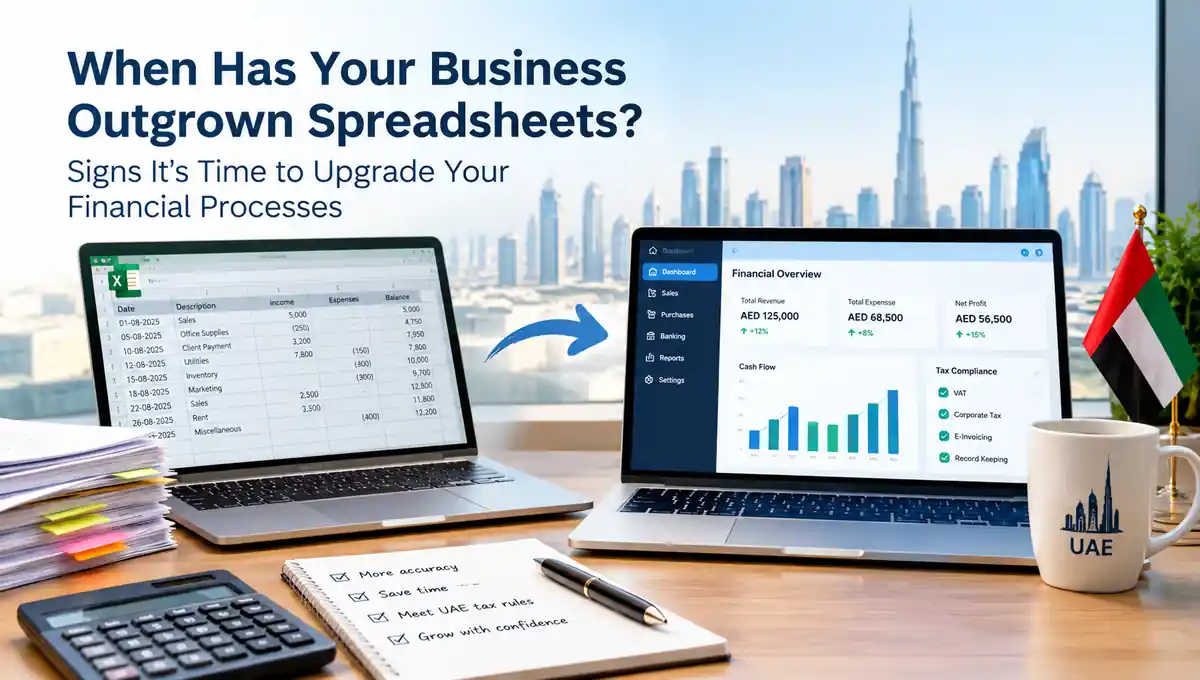
Most owners who call an accounting company in Dubai for the first time are not asking about tax. They are asking why the sales sheet no longer matches the bank statement. Spreadsheets carried the business to that point, and spreadsheets are now the thing holding it back.
A spreadsheet works while one person runs the books and volume stays low. Once a second person edits the file, or the Federal Tax Authority (FTA) asks for records, the cracks show. The signs below tell you when that moment has arrived, and what UAE tax rules demand once it has.
Signs your spreadsheets no longer fit the business
None of these signs are about the software. They are about what the business can no longer see, and each one shows up months before the tax problem does.
1. The month-end close takes longer than two weeks
A month-end close is the process of reconciling bank, sales and purchase records so you know the month’s real result. On a working spreadsheet setup, that takes a few days. When the close stretches past two weeks, something has changed. Usually the file has too many tabs, or someone is rekeying invoices by hand.
The delay matters because every decision after that point runs on old data. If you learn in mid-September that August was a loss, you have already made September’s hiring and purchasing decisions without knowing.
2. Two people hold two different versions of the numbers
The sales manager keeps one sheet. The owner keeps another. Both are “right,” and neither matches the bank. Version conflicts are the most common failure in growing businesses, and they only appear once more than one person touches the file.
The test is simple. Ask two people in the business what last month’s revenue was. If the answers differ by more than a rounding error, the spreadsheet has stopped being a system of record.
3. You cannot answer a cash question in under a minute
“How much cash is left after this week’s payroll and the VAT payment?” is a one-minute question in a proper accounting system. On spreadsheets, answering means opening three files and doing mental arithmetic. Owners in that position guess. Guessing is how a profitable company runs short of cash on the 28th of the month.
The UAE thresholds that force the upgrade
Three thresholds turn a bookkeeping preference into a legal requirement. Each one raises the bar for how records are kept, in what format, and for how long.
A. VAT registration at AED 375,000
You must register for VAT once taxable supplies and imports exceed AED 375,000 over the previous 12 months, or when you expect to cross that figure in the next 30 days. Voluntary registration opens at AED 187,500. The standard rate is 5 percent.
Registration changes the paperwork. Every taxable sale needs a tax invoice with the fields the VAT law requires, and the FTA charges AED 2,500 for each detected case where one was not issued on time. Returns are filed on the EmaraTax portal, monthly or quarterly depending on the tax period the FTA assigns you.
Records must be kept for at least five years. Failure to keep required records costs AED 10,000 per violation, rising to AED 20,000 if repeated within 24 months. A spreadsheet that gets overwritten every quarter does not meet that test.
B. Corporate tax filing within nine months of year-end
Corporate tax applies at 9 percent on taxable income above AED 375,000 under Federal Decree-Law No. 47 of 2022. The return and any payment are due within nine months of the end of the tax period. A company with a 31 December year-end files by 30 September the following year.
Records must be kept for seven years after the end of the tax period. The return is built from financial statements, which means your system must produce a profit and loss statement and balance sheet that hold up to FTA review. Linked spreadsheets rarely do.
Small Business Relief lets a resident business with revenue of AED 3 million or less elect to be treated as having no taxable income. Ministerial Decision No. 131 of 2026 extended that election to tax periods ending on or before 31 December 2029. You still register, still file, and still keep records.
C. E-invoicing from 1 January 2027 and audits at AED 50 million
E-invoicing is the threshold most owners have not planned for. From 1 January 2027, businesses with annual revenue of AED 50 million or more must issue B2B and B2G invoices as structured electronic documents through an Accredited Service Provider (ASP).
Smaller businesses follow from 1 July 2027. A PDF emailed from a spreadsheet does not qualify. The Ministry of Finance e-invoicing portal sets out the format and publishes the current list of Accredited Service Providers.
At AED 50 million a second requirement lands. Ministerial Decision No. 84 of 2025 requires audited financial statements for any taxable person above that revenue, and for every Qualifying Free Zone Person regardless of revenue. An auditor will not sign off on a set of linked spreadsheets.
| Requirement | Trigger | What changes for your records |
|---|---|---|
| VAT registration | AED 375,000 taxable supplies and imports in 12 months | Tax invoices on every sale, VAT returns, records kept five years |
| Corporate tax | All taxable persons; 9% above AED 375,000 | Return within nine months of year-end, records kept seven years |
| Small Business Relief | Revenue of AED 3 million or less, periods ending by 31 December 2029 | Elect on the return; registration, filing and records still required |
| E-invoicing | Revenue of AED 50 million or more from 1 January 2027; others from 1 July 2027 | Structured invoices sent through an ASP |
| Audit | Revenue above AED 50 million, or Qualifying Free Zone Person status | Audited financial statements each tax period |
How to move off spreadsheets
The migration fails when businesses buy software first and work out the process later. Settle the requirements, follow a fixed sequence, and know what a missed quarter costs before you start.
Decide what the system must do before choosing one
Write down requirements, not software names. For a UAE business the list is short:
- Produce VAT returns in the FTA’s format and store tax invoices with every required field
- Generate an IFRS-based profit and loss statement and balance sheet for the corporate tax return
- Hold records for seven years in a form the FTA can retrieve on request
- Connect to an Accredited Service Provider before your e-invoicing date, or have a confirmed plan to
Any platform that cannot do all four is a spreadsheet with a subscription fee.
Migrate in this order
- Fix the chart of accounts first. Most spreadsheet businesses have 200 categories where 40 will do.
- Reconcile the bank to the spreadsheet at a clean cut-off date, usually the first day of a quarter.
- Load opening balances only. Do not import three years of history; archive the old file read-only.
- Run the old sheet and the new system in parallel for one month and compare the close.
- Move invoice issuance first, then payables, then payroll.
- Retire the spreadsheet. If anyone still updates it after month two, the migration has not finished.
Any platform that cannot do all four is a spreadsheet with a subscription fee. If you cannot tell whether a platform clears all four, an accounting company in Dubai can test it against your real invoices and returns before you sign a contract.
What one bad quarter on spreadsheets costs
A Dubai trading company owes AED 120,000 in VAT for a quarter. The return goes in late because the sheet needed reworking, and payment lands four months after the due date. During an FTA review, three sales turn up with no tax invoice, and one quarter’s purchase records cannot be produced.
| Item | Basis | Penalty |
|---|---|---|
| Late VAT return | Fixed, first offence | AED 1,000 |
| Late payment | 14% per annum on AED 120,000 for four months | AED 5,600 |
| Three missing tax invoices | AED 2,500 per detected case | AED 7,500 |
| Failure to keep records | Fixed, first offence | AED 10,000 |
| Total | AED 24,100 |
That AED 24,100 is on top of the tax itself and before anyone’s time is counted. Put your annual quote for software and bookkeeping next to it.
Check your business against the thresholds before the next filing date
Pull last year’s revenue and answer three questions: are you past AED 375,000 in taxable supplies, do you know your corporate tax filing date, and which e-invoicing date applies to you. If two of the three signs in the first section also apply, the spreadsheet has already outlived its use.
The rules have moved three times in 2026. Cabinet Decision No. 129 of 2025 rewrote the VAT and Tax Procedures penalty tables from 14 April 2026, replacing the old compounding late-payment penalty with a flat 14 percent per annum.
The Ministry of Finance moved the ASP appointment deadline for large businesses from 31 July 2026 to 30 October 2026, with the 1 January 2027 go-live unchanged. Ministerial Decision No. 131 of 2026 extended Small Business Relief to 31 December 2029.
Businesses still under AED 375,000 are not exempt from any of this. Every taxable person must register for corporate tax and file a return, even when the tax due is zero. Records count from the start of the first tax period, not from the day you cross a threshold. Set a cut-off date, fix the chart of accounts, and run the parallel month before the next VAT return falls due. If you would rather not run the migration alone, an accounting company in Dubai can handle the cut-off, the chart of accounts and the parallel close while you keep running the business.