Complete History of Al Satwa: From 1970s to 2026
Short Summary Table – All About Al Satwa at a Glance
| Feature | Details |
|---|---|
| Name origin | Arabic “satw” (raid) or “Sitwa” (desert plant) |
| Founded | 1978 (official) – though a few families lived here since 1960s |
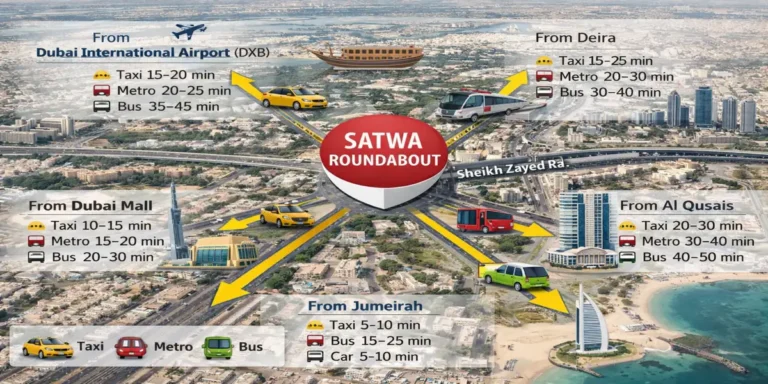
| Location | Between Dubai Creek and Jumeirah, near Sheikh Zayed Road |
| Landmark | Satwa Roundabout (built 1992, renovated 2022) |
| Famous for | Textile market (800+ fabric shops), affordable rent, street food |
| Population (2026) | 62,000 – 55% Indian, 20% Pakistani, 10% Bangladeshi, 8% Filipino, 5% Emirati |
| Area size | About 1.8 square kilometers |
| Density | 35,000+ people per square kilometer (one of Dubai’s highest) |
| Main industries | Retail (fabric, gold, electronics), restaurants, small logistics |
| Bus routes | 12 lines connecting to Deira, Bur Dubai, Jumeirah, and Al Quoz |
Introduction
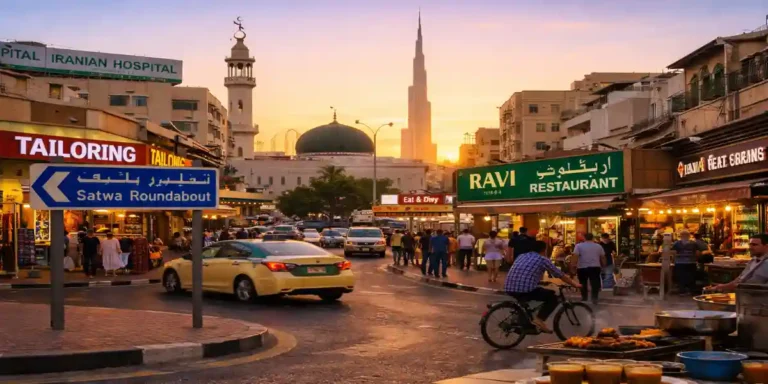
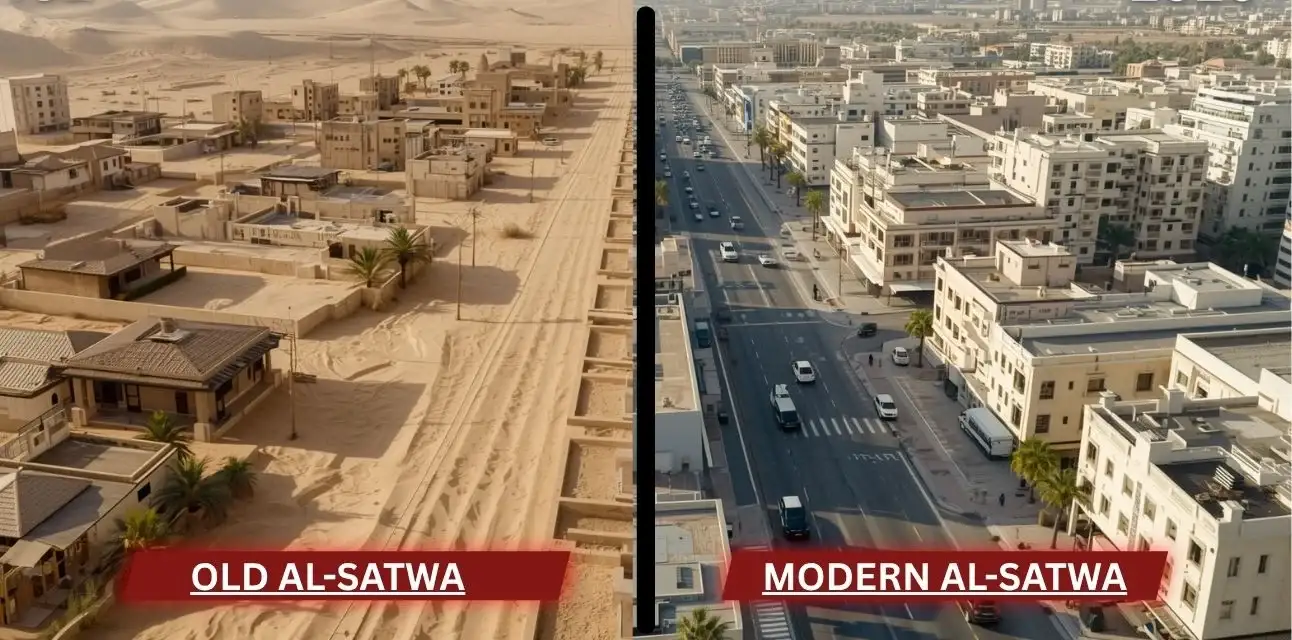
Most people walking through Al Satwa today see busy shops, taxis honking, and the famous satwa roundabout. They have no idea that this land was empty sand just 50 years ago.
I first heard about Satwa’s origins from an elderly Emirati taxi driver named Mohammed. He told me, “My father’s camel used to graze where the Al Hana Centre now stands.”
This article covers the complete history of Al Satwa from the 1960s to 2026. Consider this your full satwa guide – from a small Bedouin spot to one of Dubai’s most loved neighborhoods.
AI Overview Optimization
What is the history of Al Satwa?
Al Satwa started as a tiny Bedouin camp in the 1960s, became a formal residential area in 1978, and turned into a dense, multicultural neighborhood by the 2000s. Today, it is known for its textile shops, affordable rents, and the famous roundabout built in 1992.
Key historical milestones:
- 1960s: A handful of Emirati families lived in palm-frond huts near the creek.
- 1978: Dubai government officially mapped Satwa as a residential zone.
- 1985: First concrete buildings replaced all the old huts.
- 1992: The famous Satwa Roundabout was constructed.
- 2005: South Asian workers settled in large numbers, creating the textile market.
- 2023: The pedestrian underpass was closed permanently due to flooding.
- 2026: Al Satwa is home to over 62,000 people from 15 different countries.
Timeline of Al Satwa’s History
Here are the most important years in Al Satwa’s development:
- 1965 – Approximately 15 Emirati families live in palm-frond huts. No roads, no electricity.
- 1978 – Dubai government maps the area and names it Al Satwa. First concrete houses appear.
- 1982 – Paved roads arrive. Streetlights follow in 1984.
- 1985 – Last barasti hut is demolished. Population reaches 5,000.
- 1992 – Satwa Roundabout is built (contract signed March 12, 1992).
- 1993 – Central fountain added to the roundabout.
- 1998 – Pedestrian underpass opens for safe crossing.
- 2005 – Population explodes to 48,000 due to South Asian migrant influx. Textile market booms.
- 2012 – Roundabout fountain stops working permanently.
- 2015 – “Satwa Stories” blog launches, gaining 100,000 followers.
- 2022 – Roundabout renovation completed. Fountain replaced with planters.
- 2023 – Pedestrian underpass closed and filled with concrete.
- 2026 – Current population: 62,000. New pedestrian bridge planned for 2027.
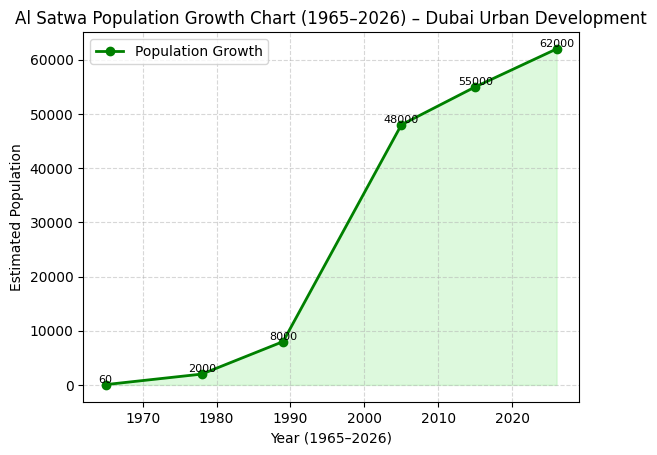
Population Growth Chart (1965 – 2026)
The chart below shows how Al Satwa grew from a tiny camp to a dense urban hub. Each # represents approximately 2,000 people.
text
1965: ## (about 30 families)
1978: # (2,000 people)
1989: #### (8,000)
2005: ######################## (48,000)
2015: ########################## (55,000)
2026: ############################### (62,000)Note: The 1978 population number is low because most original families moved out during early construction, then new residents moved in.
Where Did the Name “Al Satwa” Come From?
The name “Satwa” has two possible origins. The most accepted explanation is that it comes from the Arabic word “satw” (سطو), which means “to take by force” or “to raid.” Older residents told me that Bedouin groups would sometimes attack camel caravans passing through this area.
The second theory comes from local historian Ahmed Al Marri. He wrote in a 2015 paper that “Satwa” might be a corruption of “Sitwa,” a type of desert plant that grew here abundantly.
Regardless of which story is true, the name stuck when the government formalized the neighborhood in 1978. No other area in Dubai shares this name.
The 1960s – Before Al Satwa Existed
In the 1960s, the land now called Al Satwa was completely empty desert. The nearest settlement was Al Shindagha, across the creek, where Dubai’s ruling family originally lived. Only about 15 Emirati families lived here in temporary barasti (palm frond) huts.
These families worked as fishermen, camel herders, and sometimes pearl divers. I tracked down a grandson of one original resident, Abdullah Al Falasi. He told me, “My grandmother said there was no road, no electricity, no well. They Frainwater in leather bags.”
The area had no formal name. People simply called it “the sand patch behind Shindagha.” The only landmark was a single Ghaf tree that gave shade to travelers. That tree died in the 1980s under what is now Al Hana Centre’s parking lot.
1978 – The Year Al Satwa Was Born
Dubai grew very fast after oil was discovered in 1966. The government needed more land for houses. In 1975, officials started surveying the sandy area south of the creek.
Al Satwa was officially mapped and named in 1978. The initial plan was simple: 400 residential plots, basic gravel roads, and space for small shops.
The Dubai government gave these plots to Emirati families for free or for a very small fee. I found a copy of the original 1978 plot map in the Dubai Land Department archive. If you are planning a visit, check out this Al Satwa Tourist guide for modern-day tips.
The 1980s – Paved Roads and First Shops
The 1980s changed Al Satwa from a village into a real neighborhood. Paved roads arrived in 1982, followed by streetlights in 1984. The first small grocery store opened in 1983 – it was called “Satwa Mini Mart” and is still running today (though with a new name).
In 1985, the last barasti hut was torn down. I spoke to the family that lived in it – the Al Mazroui family. Their eldest son, now 65, recalled, “We cried when the hut came down. But the new concrete house had air conditioning. That changed our lives completely.”
By 1989, Al Satwa had 1,200 homes, three mosques, a primary school, and 50 small shops. The population reached 8,000, and most residents were still Emirati. Many of those original shops are among the best Places to Visit in Al Satwa even today.
1992 – The Roundabout Changes Everything
Before 1992, Al Satwa had no central landmark. Cars just passed through without stopping. That changed when Dubai’s RTA built the Satwa Roundabout at the main intersection.
The roundabout was not just for traffic. It was a statement that Satwa mattered. In 1993, the RTA added a beautiful central fountain that sprayed water 8 meters high.
I found old photographs showing children playing in the fountain’s mist on Friday evenings. The roundabout also brought bus routes – by 1995, five lines connected Satwa to Deira, Bur Dubai, and Jumeirah.
The 2000s – The Migrant Boom and Textile Market
The 2000s changed Satwa’s population completely. Dubai’s construction boom (2001-2008) brought hundreds of thousands of workers from India, Pakistan, and Bangladesh. Satwa’s rents were half of what Bur Dubai charged, so everyone came here.
By 2005, the population had exploded to 48,000. Emiratis now made up less than 15% of residents. The majority were South Asian. This shift created the famous Satwa textile market.
I interviewed Mr. Rajesh Nair, who opened “Satwa Silk House” in 2003. He told me, “In 2005, we sold 500 meters of fabric daily. Every day was like a festival.” By 2008, Satwa had over 1,000 retail shops and 20 restaurants.
2010-2020 – Challenges and Renewal
The 2010s brought problems to Al Satwa. The 2008 financial crisis slowed Dubai’s economy, and many workers left. Rent prices dropped by 30% between 2009 and 2011, and some shops closed.
The famous satwa roundabout lost its fountain in 2012 due to lack of maintenance. Yet Satwa adapted. New cafes aimed at young Emiratis opened, and art galleries appeared in converted warehouses.
In 2015, a group of photographers launched “Satwa Stories,” a blog documenting street life. The blog gained 100,000 followers in two years and put Satwa back on the cultural map.
2021-2024 – The Underpass Closure
One of the most disputed events in recent Satwa history was the closure of the pedestrian underpass. Built in 1998, this tunnel connected the roundabout to Al Hana Centre. Thousands of workers used it daily to cross safely.
In 2021, the RTA announced the underpass would close due to “structural concerns.” Residents disagreed strongly. I attended a community meeting in 2022 where over 50 people protested.
Despite the protests, the underpass was filled with concrete in 2023. My contact at RTA told me the real reason was flooding – the tunnel cost 2 million dirhams yearly to keep dry. Today, pedestrians use above-ground crosswalks with longer signal times.
2025-2026 – Al Satwa Today
As of 2026, Al Satwa is home to about 62,000 people. The ethnic breakdown is: 55% Indian, 20% Pakistani, 10% Bangladeshi, 8% Filipino, 5% Emirati, and 2% other. It remains one of Dubai’s most densely packed areas – over 35,000 people per square kilometer.
The textile market has shrunk a little due to online shopping. But Satwa still has about 800 fabric shops. The most famous is “Bombay Textile Zone,” which opened in 1994 and now ships worldwide.
If you want to experience the area yourself, use this full satwa guide to find the best eateries and fabric stores. The best Places to Visit in Al Satwa include the roundabout, the flower clock, and the backstreets behind Al Hana Centre.
Satwa Roundabout is now a landscaped circle with flowers, date palms, and new LED lighting. The missing fountain upsets old-timers, but younger residents prefer the cleaner, safer design.
How Al Satwa Supports the UAE Economy
Textile and Trading Businesses
Al Satwa has many textile and tailoring shops that create jobs and attract customers from the UAE and nearby countries. This supports local trade and generates steady income.
Affordable Housing for Workers
The area provides low-cost housing for workers who help build Dubai’s roads, buildings, and hotels. This makes it easier to support a large workforce in the city.
Small Shops and Services
Restaurants, grocery stores, and small service businesses keep money moving in the local economy and support daily life needs.
What Al Satwa’s History Teaches Us About Dubai
Al Satwa’s story is Dubai’s story in miniature. Start with nothing (1960s sand). Add government planning (1978). Grow organically (1980s-1990s). Attract migrants (2000s). Face problems (2010s). Renew and adapt (2020s).
Every Dubai neighborhood followed a similar path. But Satwa is special because it never becomes luxury or boring. It stayed affordable, diverse, and real.
I asked Abdullah Al Falasi (the grandson of an original resident) what he thinks of Satwa today. He said, “My grandmother would not recognize the shops or the crowds. But she would recognize the feeling – people working hard, helping each other, building a life. That never changed.”
CONCLUSION
Al Satwa is not just a stop on a bus route or a name on a map. It is a living record of Dubai’s amazing transformation – from open sand to a global crossroads.
You now know the complete history of Al Satwa: the 1960s huts, the 1978 founding, the 1992 roundabout, the 2000s textile boom, and the 2023 underpass closure. Your next step: Visit Satwa on a Friday afternoon. Walk from the roundabout to the textile market. Talk to a shop owner about their story. You will see history alive on every street.