How Do Foreign Exchange Rates Impact International Money Transfers
Sending money across borders has become a regular part of life for individuals and businesses. People transfer funds for family support, education, travel, property payments, imports, exports, and other international commitments.
However, the amount received by the beneficiary can vary depending on foreign exchange rates. Even a small movement in the exchange rate can change the final value of an international money transfer, especially when large amounts are involved.
Understanding how currency conversion works can help you make better decisions when sending money abroad.
What Are Foreign Exchange Rates?
Foreign exchange rates show the value of one currency compared with another.
For example, an exchange rate tells you how much one UAE dirham can be converted into another currency such as US dollars, euros, British pounds, or Indian rupees.
These rates can move throughout the day because currency values are influenced by:
- Supply and demand
- Interest rate expectations
- Inflation
- Economic growth
- Political developments
- Central bank decisions
- Global market conditions
As a result, the amount received after an international transfer may differ depending on the rate available when the transaction is processed.
Why Exchange Rates Matter for International Transfers
When you send money in one currency and the recipient receives it in another, currency conversion is required.
The foreign exchange rate used for that conversion directly affects how much money reaches the recipient.
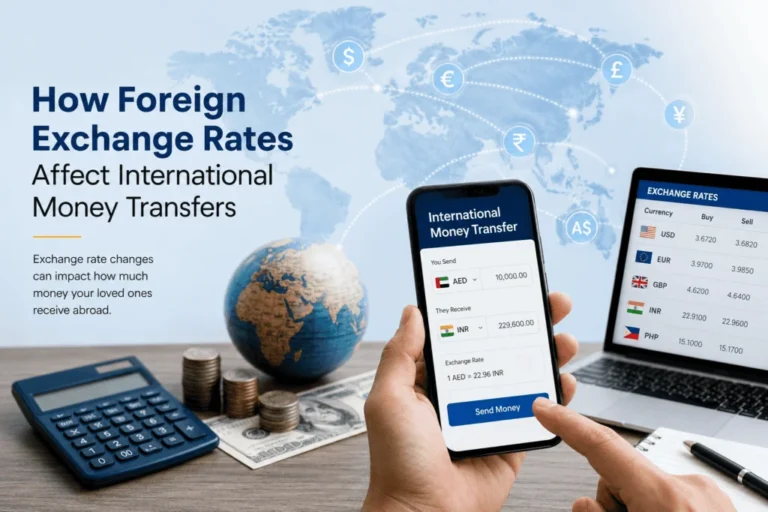
For example, if you send AED 10,000 and the receiving currency strengthens against the dirham, the recipient may receive less than they would have received earlier.
If the receiving currency weakens, the same AED amount may convert into a higher amount.
This is why exchange rates are an important part of international money transfers.
How Exchange Rate Changes Affect the Final Amount
Exchange rate movements can influence the value of a transfer in several ways.
Small Changes Can Make a Big Difference
A small currency movement may appear insignificant, but its impact becomes more noticeable when transferring large amounts.
For someone sending money for tuition fees, property payments, business invoices, or family support, even a minor rate change can affect the total value received.
Timing Can Influence Transfer Value
Currency markets can move during the day.
If you transfer money when the exchange rate is favorable, the recipient may receive more in their local currency.
If the rate moves against you, the same transfer amount may result in a lower converted value.
What Is the Difference Between the Market Rate and the Customer Rate?
The exchange rate you see online may not always be the exact rate used for your transfer.
Currency markets usually have a reference or market rate, while banks and money transfer providers may apply their own customer exchange rate.
The difference can reflect:
- Currency conversion costs
- Transfer processing
- Market conditions
- Liquidity
- Operational charges
This difference is sometimes referred to as the currency spread.
When comparing international transfer options, it is important to check the actual rate being offered rather than relying only on the market rate.
How Do Transfer Fees Affect the Total Cost?
Exchange rates are only one part of the total cost of an international transfer.
Other charges may include:
- Transfer fees
- Correspondent bank charges
- Receiving bank fees
- Currency conversion costs
- Service charges
A provider offering a low transfer fee may still offer a less favorable exchange rate.
This is why it is useful to compare both the exchange rate and the total fees before sending money.
Why Do Foreign Exchange Rates Change?
Currency values move because of changing economic and market conditions.
Interest Rates
Higher or lower interest rates can influence demand for a currency.
Inflation
Countries with lower and more stable inflation may experience stronger currency demand over time.
Economic Performance
Strong economic growth can improve investor confidence in a currency.
Political Events
Elections, trade disputes, or geopolitical developments can create currency volatility.
Global Market Sentiment
During periods of uncertainty, investors may move money into currencies they consider more stable.
These factors can all affect foreign exchange rates and, in turn, international money transfers.
How Does Currency Volatility Affect Businesses?
Currency movements are particularly important for companies that make or receive international payments.
Businesses may need to pay overseas suppliers, receive export income, settle foreign invoices, or manage international payroll.
If exchange rates move significantly between the time an invoice is issued and the time payment is made, the final cost may change.
For example, an importer may end up paying more in local currency if the foreign currency becomes stronger before payment is completed.
Businesses therefore need to monitor currency exposure as part of their financial planning.
What Should You Check Before Making an International Transfer?
Before transferring funds abroad, consider the following factors.
Check the Live Exchange Rate
Review the current rate before confirming the transaction.
Compare the Final Received Amount
Instead of looking only at the exchange rate, check how much the recipient will actually receive.
Review Transfer Charges
Look at all applicable fees, not just the headline transfer cost.
Consider Processing Time
Some transfers may be completed quickly, while others may take longer depending on the destination and payment route.
Confirm Beneficiary Details
Incorrect account details can cause delays or rejected payments.
How Does Islamic Banking Support International Transfers?
Islamic banking offers financial services that are structured in line with Sharia principles.
International transfers through Islamic banking channels generally involve transferring funds and converting currencies where required, while the overall banking relationship follows Islamic finance principles.
Customers may use digital banking, branch services, or other approved channels to send money internationally.
As with any transfer, the final value received can depend on the exchange rate, applicable fees, destination country, and processing arrangements.
Can You Reduce the Impact of Exchange Rate Fluctuations?
It is not possible to predict currency movements with certainty, but some practical steps can help manage the impact.
You can:
- Monitor exchange rates before sending large amounts
- Compare rates across available transfer channels
- Avoid focusing only on transfer fees
- Check the final amount the recipient will receive
- Plan recurring international payments in advance
- Avoid last-minute transfers when timing is flexible
For businesses, additional foreign exchange management tools may also be available depending on their banking arrangements.
Are Digital Money Transfers Better for Foreign Exchange?
Digital banking has made international transfers more convenient.
Many digital platforms allow users to:
- View indicative exchange rates
- Add beneficiaries
- Review transfer details
- Track payments
- Access transfer history
However, convenience should not be the only factor.
It is still important to review the exchange rate, applicable charges, and final received amount before confirming any transaction.
Make Every International Transfer Count
Foreign exchange rates play a major role in determining the final value of an international money transfer.
A favorable rate can increase the amount received, while an unfavorable movement can reduce it. Transfer fees, currency spreads, processing time, and banking charges can also affect the total cost.
Whether you are sending money for personal needs or managing international business payments, understanding how foreign exchange rates work can help you make more informed decisions. Customers using Islamic banking services should also compare available transfer options and review all applicable charges before completing a transaction.
Frequently Asked Questions
Why does the amount received change even when I send the same amount?
The final amount can change because foreign exchange rates move over time. Fees and currency conversion charges may also affect the amount received.
Do foreign exchange rates change every day?
Yes. Currency rates can change throughout the day depending on global economic and market conditions.
Is the online exchange rate the same rate used by banks?
Not always. Banks and transfer providers may apply a customer exchange rate that differs from the reference market rate.
What is the best way to compare international money transfers?
Compare the exchange rate, total charges, transfer speed, and most importantly, the final amount the beneficiary will receive.
Can exchange rate movements affect business payments?
Yes. Currency fluctuations can increase or reduce the cost of paying suppliers, settling invoices, and receiving international income.