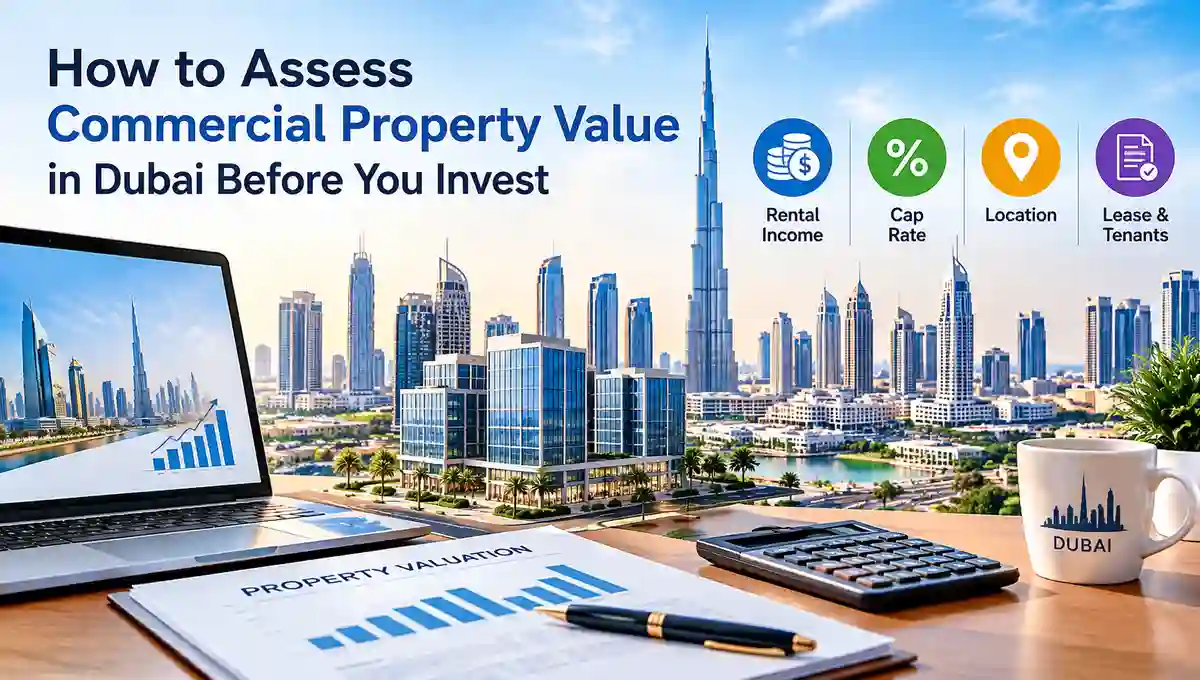
How to Assess Commercial Property Value in Dubai Before You Invest
Dubai recorded AED 176.7 billion in real estate transactions during Q1 2026 alone, a 23.4% jump year on year across nearly 48,000 deals. For investors eyeing offices, retail units, or warehouses, that volume means opportunity, but only when the numbers are right. Consequently, understanding commercial property value before committing capital is the single most important step in any Dubai investment thesis.
Regardless of whether you are a first-time buyer or a portfolio investor expanding across Business Bay, DIFC, or JLT, the principles that determine what a commercial asset is actually worth remain consistent. In this article, we break down the core drivers, common pitfalls, and practical benchmarks that shape commercial property value in the emirate today.
Why Commercial Property Value Differs from Residential
Residential buyers compare similar apartments in the same tower. By contrast, commercial investors face a fundamentally different equation. Instead of looking at per-square-foot sale prices alone, a proper commercial building valuation hinges on how much income the asset can generate, how reliably that income flows, and what risk premium the market assigns to both.
As a result, two offices of identical size in the same district can carry valuations that differ by 40–60% depending on tenant quality, remaining lease term, and fit-out condition. Similarly, a vacant warehouse in Dubai South carries a very different risk profile from a fully leased logistics facility with a five-year contract.
For a deeper breakdown of the methodologies RERA-certified valuers use including the income approach, the sales comparison approach, and the cost approach, the valuation experts at Divine LiWing have published a practical guide that covers each method with worked examples and local benchmarks.
The Four Drivers Behind Every Commercial Valuation
Every professional commercial building valuation in Dubai ultimately rests on four pillars. Understanding each one protects you from overpaying and reveals where genuine upside hides.
1. Net Operating Income (NOI)
Essentially, NOI is gross rental income minus operating expenses, service charges, maintenance, insurance, and management fees. Crucially, it excludes debt service. The higher and more stable the NOI, the higher the property’s value. Therefore, investors who secure long leases with creditworthy tenants create a natural floor under their asset’s worth.
2. Capitalisation Rate (Cap Rate)
In simple terms, cap rate is the market’s required yield on a commercial asset. Dividing NOI by the property’s market value produces the cap rate. Conversely, dividing NOI by the prevailing cap rate for a given asset class produces the property’s indicative value.
Q: What is a good cap rate for commercial property in Dubai?
A: Cap rates vary by asset class and location. Prime offices in DIFC trade at 6.5–7.5%, while Grade A offices in JLT yield 8–9%. Retail units in high-footfall malls sit around 7–8%, and warehouses in Dubai South or DIP offer 8.5–10%. A “good” cap rate depends on your risk tolerance and return expectations.
3. Location and Micro-Market Dynamics
For example, a Grade A office in DIFC commands AED 200–350 per square foot annually, while equivalent space in JLT achieves AED 80–120. Because valuers capitalise these rental figures, location-driven rent gaps translate directly into valuation differences of 100–200%. Furthermore, proximity to the Metro Blue Line, major arterial roads, and lifestyle amenities can shift rents and therefore value within the same district.
4. Lease Structure and Tenant Creditworthiness
An asset leased to a government entity for ten years is valued very differently from a similar space on a rolling one-year contract with a startup tenant. Longer lease terms with contractual escalation clauses reduce income risk, lower the applied cap rate, and ultimately push commercial property value upward.
Dubai Cap Rate Benchmarks by Asset Class (2026)
The table below offers a practical snapshot. However, every property is unique, and a formal valuation from a certified professional is essential before making investment decisions.
| Asset Class | Typical Location | Indicative Cap Rate | Avg. Rent (AED/sq ft/yr) |
|---|---|---|---|
| Prime Office | DIFC | 6.5–7.5% | 200–350 |
| Grade A Office | Business Bay | 7–8.5% | 120–180 |
| Grade A Office | JLT | 8–9% | 80–120 |
| Retail (High Footfall) | Downtown / Marina | 7–8% | 250–400 |
| Warehouse / Logistics | DIP / Dubai South | 8.5–10% | 35–55 |
| Mixed-Use | Business Bay | 7.5–9% | 100–160 |
Common Mistakes That Destroy Commercial Property Value
Unfortunately, even experienced investors make valuation errors in Dubai’s fast-moving market. Below are the three most frequent and the most costly.
- Ignoring DEWA and service charge escalations. Operating expenses in Dubai can swing by 15–25% depending on the building’s age and management efficiency. Underestimating these costs inflates your projected NOI and leads to overpayment.
- Using residential comparables. Applying a per-square-foot benchmark from a residential sale to a commercial asset ignores the income stream entirely. Commercial assets are priced on yield, not comparable unit prices.
- Overlooking vacancy risk. A property valued at 100% occupancy is worth significantly less if the anchor tenant’s lease expires in six months. Professional valuers stress-test NOI against realistic vacancy scenarios.
Q: How much does a commercial property valuation cost in Dubai?
A: RERA-certified valuers typically charge AED 2,500–15,000 depending on asset complexity, size, and purpose. A standard office valuation sits at the lower end, while multi-building portfolios or development land may reach AED 25,000 or more. Given that a 5% valuation error on a AED 10 million asset equals AED 500,000, the fee is negligible insurance.
How to Get a Reliable Valuation
Dubai’s Real Estate Regulatory Agency (RERA) mandates that all formal valuations for mortgage, sale, or dispute purposes be conducted by a RERA-certified valuer. Choosing a certified professional ensures the valuation complies with RICS Red Book standards and is accepted by banks, courts, and the Dubai Land Department.
Before commissioning a valuation, gather these documents:
- Title deed (or Oqood for off-plan)
- Existing lease agreements with rental schedules
- Service charge and DEWA statements for the last 12 months
- Floor plans and building specifications
- Recent maintenance or fit-out invoices
Additionally, having these ready speeds up the process and ensures the valuer captures operating expenses accurately — a step that directly affects the final figure. In fact, experienced consultancies often advise clients to prepare a complete documentation pack before the valuer’s first site visit.
When Should You Reassess Commercial Property Value?
Importantly, a single valuation is a snapshot, not a permanent answer. Market conditions, lease events, and physical changes all shift value over time. Reassess in these situations:
- Before acquisition or disposal – to anchor your negotiation with an independent figure
- At lease renewal or expiry – tenant departure or re-letting at a new rate resets NOI
- After significant capital expenditure – a major fit-out or systems upgrade can justify a higher rent and, therefore, higher value
- Annually for portfolio reporting – institutional investors and funds require year-end mark-to-market valuations
- When market fundamentals shift – interest rate changes, new supply, or zoning amendments can move cap rates across an entire district
The Role of Expert Advisors
Getting the valuation right is only part of the picture. Pairing it with market intelligence knowing which districts are tightening, which tenant profiles are expanding, and where new supply will land turns a number on paper into a genuine investment advantage.
Divine LiWing, a luxury real estate consultancy headquartered in Business Bay, combines RERA-compliant valuation guidance with on-the-ground market data to help investors make decisions backed by both numbers and context. For a comprehensive walkthrough of valuation methods, cap rate benchmarks, and location-level analysis, their guide to commercial property valuation in Dubai is a practical starting point.
Frequently Asked Questions
Q: What determines commercial property value in Dubai?
A: Four factors drive commercial property value in Dubai: net operating income (NOI), the prevailing capitalisation rate for the asset class, the property’s location within the emirate, and the quality and length of existing lease agreements. Together, these inputs feed the income approach, the primary method used by RERA-certified valuers for income-producing commercial assets.
Q: Is commercial building valuation different from residential valuation?
A: Yes. Commercial building valuation focuses on income-generating potential and applies methods like the income capitalisation approach and discounted cash flow analysis. Residential valuation, by contrast, relies heavily on comparable sales data. The tenant profile, lease structure, and operating expenses that matter in commercial valuations rarely apply to residential properties.
Q: Can foreign investors own commercial property in Dubai?
A: Foreign nationals can purchase freehold commercial property in designated areas across Dubai including Business Bay, DIFC, JLT, Downtown, and Dubai Marina. Freehold ownership grants full title with no local sponsor required. Additionally, commercial property owners investing AED 2 million or more may qualify for a UAE Golden Visa.
Q: How often should I get my commercial property revalued?
A: At minimum, every two to three years or whenever a material event occurs: a lease expiry, a major refurbishment, a shift in market yields, or a new supply announcement in the district. Institutional portfolios are typically revalued annually for financial reporting compliance.
Q: What cap rate should I expect on a Dubai warehouse in 2026?
A: Industrial and logistics assets in Dubai Investment Park (DIP) and Dubai South currently trade at indicative cap rates of 8.5–10%. These higher yields reflect the lower per-square-foot rents compared to offices, balanced by strong demand from e-commerce, third-party logistics operators, and last-mile distribution networks.