
800G FR4 in AI Clusters: Balancing Reach, Cost, and Complexity
As AI clusters scale up, network design is starting to feel less like traditional data center planning and more like system engineering. GPU density keeps increasing, rack power is going up, and the traffic pattern between nodes is becoming more demanding every generation.
In this environment, 800G optics are no longer experimental, they are quickly becoming part of the default design toolkit. Among the available options, 800G FR4 is often the one that ends up being used in places where teams need a balance between reach, cost, and operational simplicity.
Expanding Physical Scale in AI Cluster Architectures
A few years ago, most high-speed connections stayed within a single rack or between adjacent racks. That is no longer the case. Modern AI clusters are built in a much more distributed way. GPU nodes may sit across multiple rows, and in larger deployments, across multiple halls or even separate buildings within the same campus.
Once you start looking at real cabling paths, not just straight-line distances, it becomes clear that short-reach optics like SR8 are not always enough. Even if the physical distance looks manageable on paper, routing through trays, patch panels, and structured cabling easily pushes links beyond the safe margin.
The Practical Reach Advantage of 800G FR4
800G FR4 typically supports around 2km over single-mode fiber using duplex LC connectors. That range might sound excessive for “intra-data center” links, but in real deployments, it is actually quite practical.
It covers:
- Cross-rack connections in large AI pods
- Inter-row spine-to-leaf links in big halls
- Connections between separate AI buildings on the same campus
- Early-stage expansion where topology is not fully finalized
The key advantage is not just distance, it is flexibility. Teams do not have to redesign the optical layer every time the physical layout changes slightly.
Limitations of 800G SR8 in Large-Scale Deployments
800G SR8 is attractive because it stays on multimode fiber and uses parallel optics, which feels familiar for many data center teams. But SR8 comes with constraints that become more visible at scale.
The biggest limitation is reach. In tightly packed environments it works fine, but once cabling paths get longer or less predictable, margin disappears quickly. On top of that, SR8 relies on MPO infrastructure, which adds complexity in polarity management, cleaning, and troubleshooting.
In smaller clusters, this is manageable. In large AI fabrics with thousands of links, it starts to become operational overhead.
Design Considerations for 800G DR8 Architectures
On the other side, 800G DR8 is very capable in terms of reach and bandwidth, but it introduces a different trade-off. It still uses parallel optics, but over single-mode fiber, and typically requires more careful infrastructure planning. In many cases, it also pushes teams toward MPO-based designs, which brings back the same cabling complexity that operators often try to reduce.
DR8 makes sense in some hyperscale environments, but it is not always the simplest choice for mixed-distance AI clusters.
The Position of FR4 in Practical Network Design
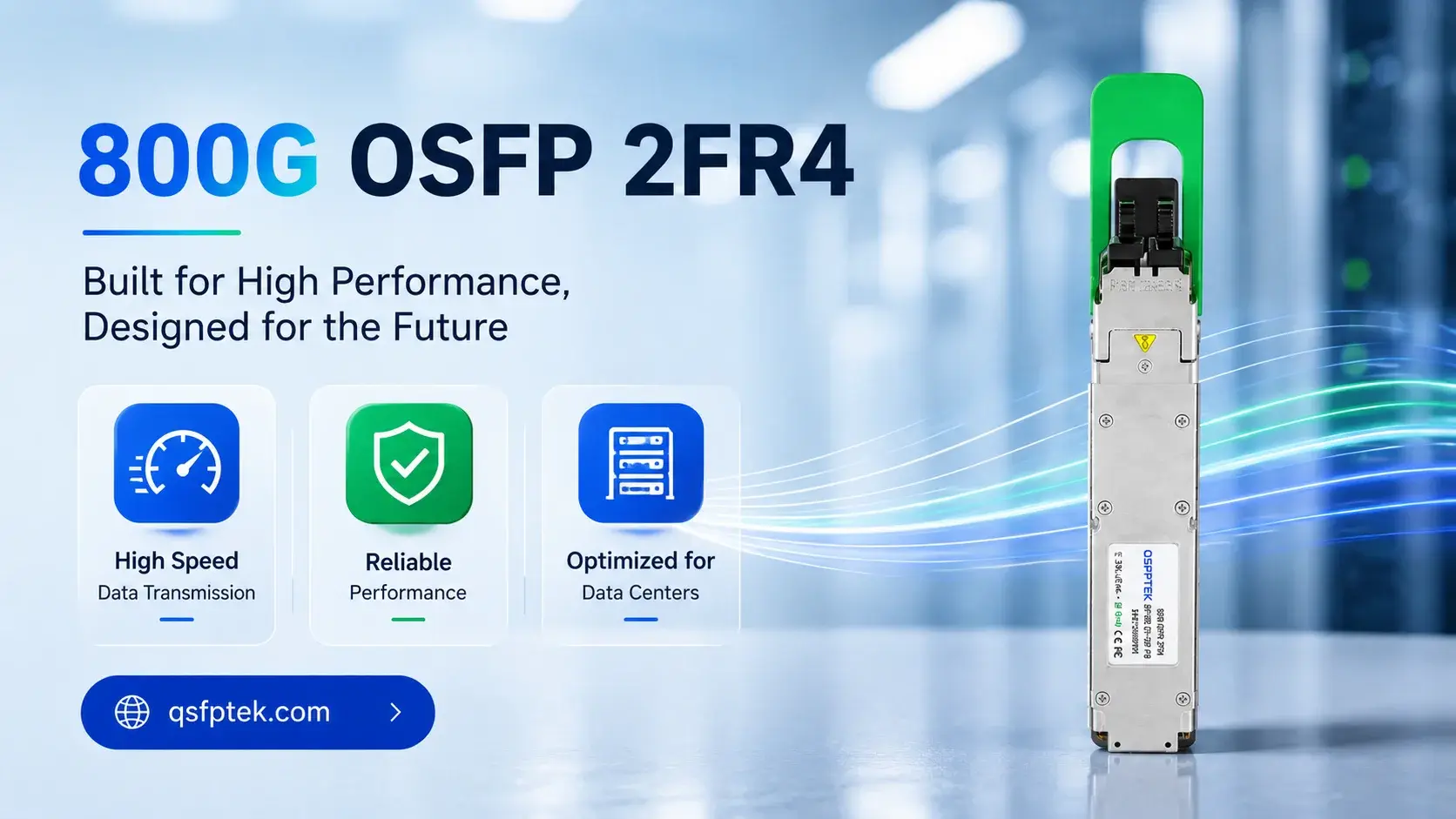
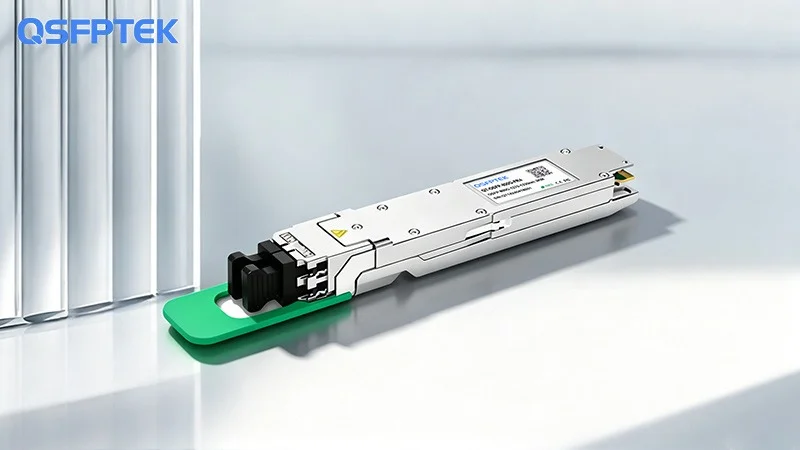
800G OSFP FR4 sits in a more pragmatic position. It uses duplex LC, which most data centers are already comfortable with. That alone reduces friction during deployment. More importantly, it avoids the density and polarity challenges of MPO while still delivering single-mode reach.
In AI clusters, this combination is often what teams are actually looking for: not the absolute lowest cost per bit, and not the maximum theoretical performance, but something that works reliably across a messy, evolving physical layout.
Conclusion
800G FR4 is not trying to replace SR8 or DR8, it is filling a very specific gap that becomes more important as AI clusters grow in size and complexity. SR8 works well when distances are short and predictable.
DR8 fits environments that are highly structured and optimized for scale. FR4 sits in the middle, handling the reality of modern AI deployments where reach, flexibility, and operational simplicity all matter at the same time.