Why Car Batteries Struggle More During Stop-and-Go Dubai Traffic?
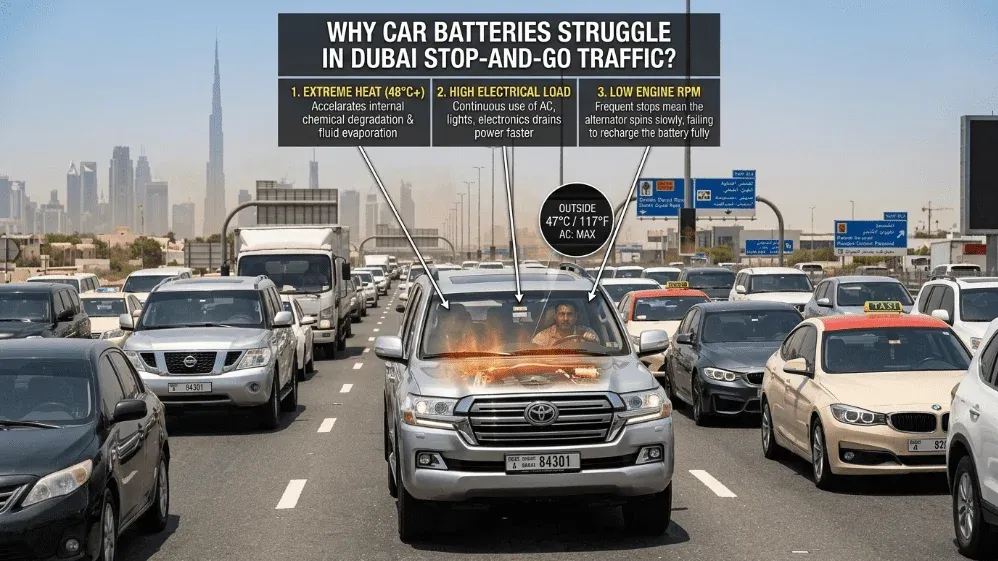
Car batteries do not die randomly. In stop-and-go traffic across the UAE, they die for one specific reason: the alternator never gets the chance to fully recharge them. Fix this problem, and you can add 12 to 18 months to your battery’s life.
At Sayara Battery, we respond to hundreds of call-outs and provide the best Dubai car battery across the UAE every month. Drivers commuting through heavy city traffic in Dubai, from Karama to DIFC or JVC to Al Quoz, consistently show the same problem. Their battery never recovered from yesterday’s commute. Here is exactly why that happens and what you can do about it.
What Stop-and-Go Traffic Actually Does to a Car Battery?
Every engine start pulls 150 to 400 amps from the battery. The alternator is supposed to return that energy as you drive. The problem is that the alternator only reaches full output above 1,500 to 2,000 RPM. In stop-and-go traffic, your engine idles at 700 to 900 RPM most of the time.
So the alternator recharges the battery to maybe 60 to 75 percent before you park. The next morning, you drain it again. The alternator once more falls short. This cycle repeats every single day.
PSoC cycling is the dominant failure mechanism for lead-acid batteries in urban driving, and Dubai’s traffic conditions make it worse than almost any other city in the region. Research in the Journal of Energy Engineering confirms that standard flooded batteries fail rapidly under PSoC conditions, while AGM batteries perform significantly longer under the same test.
The 8 Compounding Reasons Dubai Traffic Accelerates Battery Failure
1. Chronic Undercharging Due to Low-RPM Idling
Morning commutes on Emirates Road or the E311 interchange keep traffic at a walking pace for 30 to 45 minutes. During this time, the AC draws 15 to 25 amps continuously. The alternator at idle barely keeps pace with current demand, let alone recharges the battery. The battery loses net charge on every slow commute.
2. Heat Accelerates Sulfation at Partial Charge
Sulfation occurs when lead sulfate (PbSO4) crystals build up on battery plates during periods of low charge. Normally, these crystals are reversible. Under sustained heat, they harden and become permanent.
Research in the Journal of Power Sources shows that PSoC operation progressively increases internal battery resistance through sulfate accumulation until the battery fails.
Inside a parked car on a hot UAE afternoon, cabin temperatures regularly exceed 75°C. At that temperature, crystal hardening happens within 24 to 48 hours of the battery sitting at partial charge.
3. Air Conditioning Load Overwhelms the Alternator in Traffic
Running the AC from April through October is not optional in the UAE. The AC compressor alone draws 10 to 20 amps. Add headlights, infotainment, rear-view cameras, and phone charging, and total electrical demand reaches 40 to 60 amps.
At low RPM in traffic, the alternator may only output 50 to 70 amps. The battery fills the gap, discharging further with every red light.
4. Frequent Engine Starts Compound the Drain
Each cold engine start pulls a large amp burst from the battery. During a 40-minute urban commute with three to five stop-and-restart cycles, the cumulative cranking load is measurable. A single long highway drive puts far less strain on the battery than a stop-heavy urban commute of the same duration.
5. Battery Age Meets the Wrong Environment
Standard flooded lead-acid batteries are rated at 25°C. For every 10°C increase above that baseline, internal degradation accelerates.
At UAE summer temperatures of 45°C to 50°C, a standard battery ages at nearly twice its rated speed. A battery rated for four years in a temperate climate realistically lasts two to two and a half years under these conditions.
6. Parasitic Drain During Long Parking Periods
Alarm modules, telematics units, Bluetooth, OBD-II dongles, and dash cameras draw a combined 20 to 80 milliamps even when the engine is off. Over a 10-hour workday, that totals 0.5 to 0.8 amp-hours of continuous drain.
For a battery already sitting at 70% charge from the morning commute, this pushes it below the 50% threshold where sulfation becomes severe and largely irreversible.
7. Terminal Corrosion Reduces Charging Efficiency
Coastal humidity in areas near the waterfront accelerates white powdery corrosion on battery terminals. Even moderate corrosion increases electrical resistance between the alternator and battery.
A corroded terminal can waste 15 to 20% of available charging current as heat rather than transferring it into the battery. This further slows the already insufficient recharging during traffic commutes.
8. Wrong Battery Type for Urban Driving
Most vehicles use standard flooded lead-acid batteries. These are the worst-suited technologies for stop-and-go urban driving. High-end vehicles face even tougher conditions, which is why luxury cars in Abu Dhabi require specialized battery care to handle intense electrical demands. The same Journal of Energy Engineering study found that a standard flooded battery failed after just 2 PSoC test units, while an AGM battery completed 16 units under identical conditions.
AGM batteries accept charge faster at low RPM and resist sulfation significantly better than flooded batteries.
The 5 Warning Signs Your Battery Is Losing Against Traffic
Catch these 5 early signs before you are stranded on a busy road in Dubai:
- Slow engine cranking, especially on Monday mornings after a weekend of short trips
- Dashboard battery warning light that appears during or after a heavy traffic commute
- Headlights that dim at idle and brighten when you rev the engine above 1,500 RPM
- Electrical accessories behaving erratically: power windows slow, touchscreen reboots, Bluetooth drops
- The car starts fine in the morning, but struggles after a short afternoon errand, which is classic PSoC cycling behavior.
How to Prevent Car Battery Failure in Stop-and-Go Traffic: 7 Proven Steps
Step 1: Switch to an AGM Battery Rated for High-Cycle Use
To prevent stop-and-go car battery failure, replace your flooded battery with an AGM unit of equal or greater capacity. Reliable options for UAE conditions include Bosch (S5 and S6 AGM), Varta (Silver Dynamic AGM), and Exide (AGM series).
AGM batteries charge faster at low RPM, resist sulfation, and outlast flooded batteries by 40 to 60% in urban driving.
Step 2: Conduct a Battery Health Check Every 6 Months
Schedule a conductance test every 6 months. A conductance test measures true remaining capacity, not just surface voltage.
Test before Ramadan dawn commutes and before the Dubai summer heat peaks. Sayara Battery technicians perform these checks at your location across the UAE.
Step 3: Take a Highway Drive Once a Week
Drive on a major highway at speeds above 80 km/h for at least 20 minutes once a week. At sustained highway RPM, the alternator fully recharges the battery and dissolves early-stage sulfate crystals before they harden.
This one habit makes a measurable difference for city-only commuters.
Step 4: Reduce Parasitic Drain During Parking Hours
Unplug OBD-II dongles and aftermarket GPS trackers that stay powered when the engine is off. Confirm all interior lights are off before leaving the vehicle.
Every milliamp saved during parking hours preserves the charge margin the battery needs for tomorrow’s commute.
Step 5: Clean Battery Terminals Quarterly
Mix one tablespoon of baking soda into 250 ml of water, apply to terminals, scrub, and rinse dry. Finish with a thin layer of petroleum jelly or terminal protector spray.
Clean terminals cut charging resistance so the alternator delivers its full output to the battery rather than losing it to heat at corroded contacts.
Step 6: Park in Shaded or Covered Areas
Covered parking reduces vehicle interior temperature by 15 to 25°C compared to open surface lots in direct sun. Lower battery temperature slows sulfation, reduces fluid evaporation in flooded cells, and preserves charge retention between commutes.
A reflective windscreen shade is a practical alternative for areas with limited covered parking, such as industrial zones.
Step 7: Address Alternator Issues Before They Kill the Battery
A weakening alternator gives itself away. Watch for headlights that brighten noticeably when you rev above idle, a battery warning light that only appears in traffic, or a battery under 12 months old that already needs a jump-start. These are alternator symptoms, not battery symptoms.
Replacing the battery without fixing the alternator guarantees a repeat failure. Sayara Battery includes a full charging system diagnostic with every battery replacement.
The Best Time of Year to Replace Your Car Battery in Dubai
Battery failure peaks in 2 seasons:
Summer (June to August): Heat-accelerated degradation causes sudden failures. Batteries that survived spring collapse under sustained 45°C+ temperatures.
Post-Summer (September to October): Batteries that limped through summer, deeply sulfated and capacity-reduced, fail in the first week of cooler weather when drivers attempt longer trips.
Replace your battery in March or April before summer heat accelerates any existing degradation. A pre-summer replacement costs less than a post-breakdown emergency replacement every time.
AGM vs. Standard Flooded Battery for Stop-and-Go Driving
| Feature | Standard Flooded Lead-Acid | AGM Battery |
| Cycle life at partial charge | Fails at 2 PSoC test units | Completes 16 PSoC test units |
| Charge acceptance at low RPM | Low | High |
| Heat tolerance | Moderate | Good |
| Sulfation resistance | Low | High |
| Typical lifespan in the UAE | 18 to 30 months | 36 to 54 months |
| Price range | AED 250 to 500 | AED 550 to 1,100 |
For Dubai commuters spending 45 or more minutes daily in stop-and-go traffic, the AGM battery pays for its premium within the first replacement cycle, saving the cost of a breakdown, a tow, and an early repeat replacement.
Why Choose Sayara Battery for a Car Battery in Dubai?
Sayara Battery provides fast, professional mobile car battery replacement across the UAE. From Jumeirah to Jebel Ali and from Al Quoz to Mirdif, our technicians come to you.
- Mobile service across all areas, at home, at the office, or roadside
- AGM and standard battery options from leading brands, matched to your vehicle specifications
- Full charging system diagnostics are included with every replacement
- 24/7 availability because battery failure does not respect office hours
- Transparent pricing with no surprises before we begin
Contact Sayara Battery today if your battery is struggling. We respond fast, diagnose accurately, and install right, so you drive tomorrow morning confidently, wherever the commute takes you across Dubai.