
How Sharjah’s Urban Boom Is Driving Facade Cleaning Demand
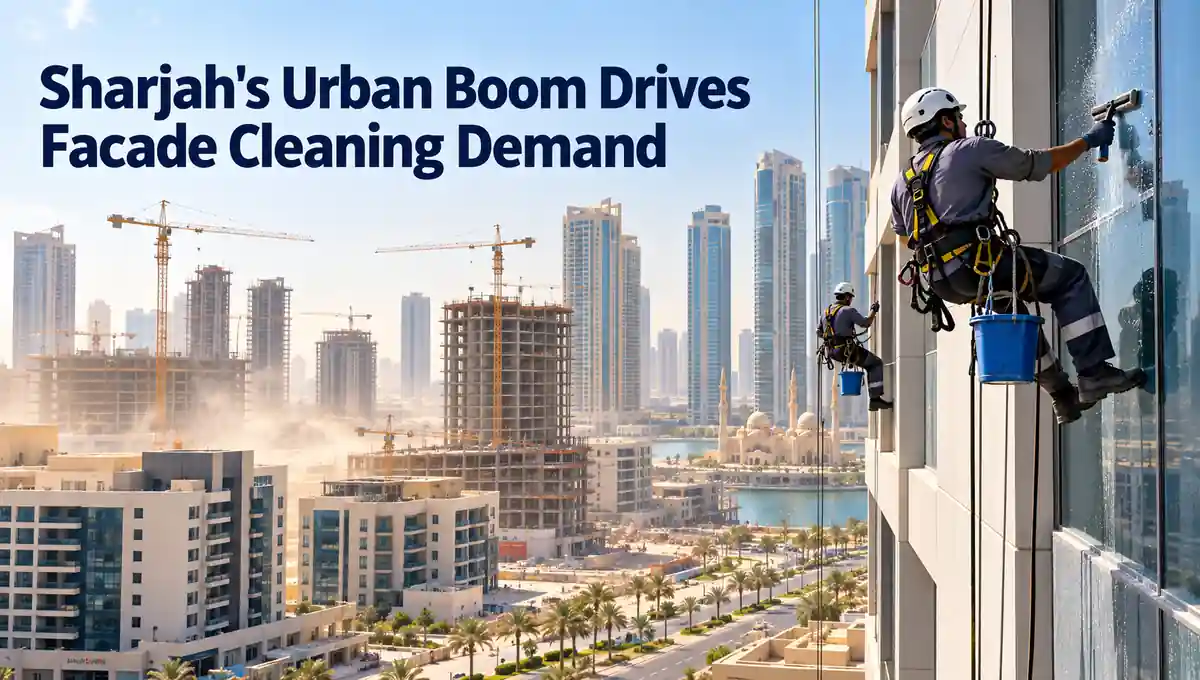
Stand on a balcony in Muwaileh and count the cranes. Ten years ago, this was the edge of the city. Today it sits beside Aljada, a 24-million-square-foot district already home to more than 20,000 residents, with new residential blocks handed over every few months.
Now look at the buildings that were already there. The same construction activity that makes the area attractive is coating their windows, walls and balcony railings in fine cement dust. Their owners didn’t change anything. Their environment changed around them.
That’s the pattern repeating across Sharjah right now, and it’s quietly reshaping what building maintenance costs and how often it’s needed. At Frontline Technical Services, we see it in the scheduling: buildings that used to book an annual clean are moving to quarterly, and new towers are booking before their first tenants arrive.
Quick answer:
Sharjah’s population has passed 1.9 million and roughly 33,700 new homes are scheduled for delivery by 2030. That growth means more facades to maintain, more construction dust settling on existing buildings, taller and more glass-heavy elevations, and older stock competing with brand-new supply. All four push exterior cleaning from an occasional job to a scheduled one.
The Scale of the Build-Out
| Indicator | Figure |
|---|---|
| Sharjah metro population (2025) | About 1.91 million, up 2% year on year |
| Residential rental contracts registered (2025) | Around 290,000, up from 278,000 in 2024 |
| Share of rental contracts taken by families | 86% |
| Homes delivered in 2025 | About 2,600, more than 80% apartments |
| Apartments delivered in Q1 2026 alone | About 1,100 |
| Homes scheduled for delivery by 2030 | About 33,700, including 24,800 apartments |
Those figures, from Cavendish Maxwell’s 2026 market research, describe a city adding density rather than just land. The dominant new product is the apartment building, and apartment buildings have something villas don’t: tall, continuous facades that nobody can reach from the ground.
Add the master developments driving much of this, and the picture sharpens. Aljada alone has passed 8,200 completed homes. Masaar is delivering 3,000 villas and townhouses across a 19-million-square-foot site. Maryam Island, Al Mamsha and Tilal City are all in delivery phases.
Four Ways Urbanization Creates Cleaning Demand
1. More buildings, more facades
This is the obvious one, but the shape matters more than the number. More than 80% of 2025’s new supply was apartments, and 24,800 of the 33,700 homes due by 2030 are apartments. Every one of those towers has glass, cladding and painted render that weathers in the same sun and salt air as everything else.
2. Construction dust lands on finished buildings
Existing owners absorb a cost they never budgeted for. Cement dust, silica and site grit travel well beyond the hoarding line, and they don’t rinse off like ordinary desert dust. Fine cement particles are alkaline and can etch glass if left to sit through humid nights.
In active areas like Muwaileh, Al Tai and Suyoh, buildings next to live sites often need cleaning at roughly double their usual frequency until the works finish. Booking a professional facade cleaning service in Sharjah on a shorter cycle during nearby construction is cheaper than restoring etched glass afterwards.
3. Taller and denser means harder access
Sharjah’s older stock was mostly low-rise, where a ladder or a water-fed pole could reach most of the building. The new profile is different: mid- and high-rise towers with recessed balconies, curved corners and full-height glazing.
| Building type | Typical access method |
|---|---|
| Low-rise villas and 2–4 storey blocks | Water-fed poles from ground level |
| Mid-rise towers (5–15 floors) | Rope access, or cradles where installed |
| High-rise and complex facades | Rope access with roof anchors |
| Podiums, canopies and entrances | Ground-level equipment |
For most of Sharjah’s newer buildings, rope access cleaning has become the default rather than the exception, because it reaches every elevation without scaffolding or road occupation. We break down the cost and safety side of that in our guide to rope access for Sharjah towers.
4. Older buildings now compete with new supply
With around 290,000 rental contracts registered in 2025 and families making up 86% of them, tenants have real choice. A 15-year-old building in Al Nahda or Al Taawun is no longer competing only with its neighbours; it’s competing with brand-new apartments in Aljada and Maryam Island.
Presentation is the cheapest lever an older building has. A clean facade, clear glass and a tidy entrance close a surprising amount of the gap, at a fraction of the cost of renovation. That’s why many owners now pair a regular building cleaning service in Sharjah with periodic repainting through painting services in Sharjah.
The Environmental Factors That Haven’t Changed
Urbanization adds to a workload that was already heavy:
- Coastal salt along the corniche and in Al Khan, Al Mamzar and Al Majaz, which bonds to glass and corrodes fixings.
- Desert dust from the east, deposited year-round and heavily after every shamal.
- Summer humidity that turns settled dust into a film rather than letting it blow off.
- Birds, whose acidic droppings stain ledges and reveals; bird spikes keep them off between cleans.
Combine a heavier dust load with more buildings and taller elevations, and the maintenance requirement compounds rather than adding up.
What This Means for Owners and Facility Managers
Book earlier than you think you need to. Certified rope access capacity in the northern emirates is finite, and more buildings are competing for it every year. Annual contracts get calendar slots; one-off callers take what’s left.
Treat handover cleaning as its own job. Post-construction cleaning, removing cement splash, silicone smears, protective film residue and grout haze, is a different task from routine washing, and it should happen before the first tenants move in.
Shorten the cycle while neighbouring sites are active. Then return to normal intervals once the works are done.
Clean glass more often than walls. Glass shows a fraction of the deposit that concrete hides, so window cleaning and building glass cleaning usually run on shorter cycles than full facade work.
Use each clean as an inspection. Ask for a condition note on sealant, fixings and staining. It’s the cheapest structural check a building gets, and it’s part of what regular facade cleaning protects against.
Looking Ahead to 2030
If the delivery pipeline holds, Sharjah will add roughly 33,700 homes by 2030, most of them in apartment buildings. That’s tens of thousands of square metres of new facade entering a maintenance cycle, in a climate that offers no relief, next to construction that will continue for years.
For owners, the practical takeaway is simple. Exterior cleaning in Sharjah is shifting from something you arrange when a building starts to look tired to something you schedule, budget and contract in advance, the same way you already do for lifts and air conditioning.
FAQs
1. Why do buildings in Sharjah need cleaning more often than before?
Because construction activity, denser development and the emirate’s dust and salt air combine. Buildings near active sites often need cleaning at roughly double their usual frequency.
2. How often should a Sharjah building be cleaned?
Most facades benefit from a clean every 6 to 12 weeks depending on exposure, with glass usually needing a shorter cycle. Coastal and construction-adjacent buildings sit at the shorter end.
3. Does construction dust actually damage buildings?
It can. Cement dust is alkaline and, left on glass through humid nights, can etch the surface. Removing it early is far cheaper than restoration.
4. What’s the best cleaning method for Sharjah’s new towers?
Rope access, in most cases. It reaches every elevation, needs no scaffolding, and doesn’t block entrances or parking.
5. When should a new building get its first clean?
Before handover. Post-construction cleaning removes cement splash, silicone and film residue that routine washing isn’t designed for.